image from : www.wired.com
In the vast cosmic tapestry, few phenomena ignite as much fascination and fear as black holes. These regions of spacetime exhibit such immense gravitational pull that nothing—not even light—can escape once it crosses a certain boundary. Far from being mere “holes” in space, black holes are among the most profound and energetic objects in the cosmos, continuously challenging our understanding of physics and the very fabric of reality.
What Exactly Is a Black Hole? More Than Just a Void
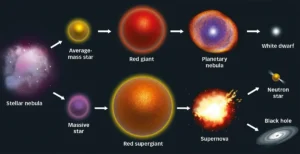
The term “black hole” was coined in 1967 by physicist John Wheeler, but the concept dates back to the late 18th century. Fundamentally, a black hole forms when a massive star collapses under its own gravity at the end of its life cycle.
The Anatomy of an Event Horizon

Source : www.empireonline.com
Every black hole is defined by its event horizon—often called the “point of no return.” This is not a physical surface, but rather a boundary in spacetime. Once matter or light crosses this threshold, it is irrevocably pulled towards the singularity at the black hole’s core.
- Singularity: The theoretical center of a black hole where matter is crushed to infinite density, distorting spacetime in unimaginable ways. Our current laws of physics, specifically General Relativity, break down at this point, highlighting the need for a unified theory of quantum gravity.
- Schwarzschild Radius: This is the radius of the event horizon. For an object to become a black hole, its entire mass must be compressed within this radius. For instance, if our Sun were compressed to the size of a small city (about 3 km in radius), it would become a black hole.
The Birth of a Cosmic Leviathan: How Black Holes Form
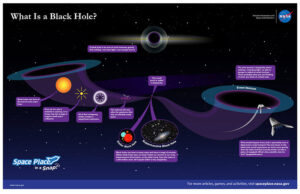
Source : spaceplace.nasa.gov
Black holes aren’t uniform; they come in several sizes, each with a distinct origin story.
1. Stellar Black Holes
These are the most common type, formed from the gravitational collapse of giant stars. When a star at least 20 times more massive than our Sun exhausts its nuclear fuel, its core can no longer withstand the immense inward pressure of gravity. It collapses, triggering a supernova explosion that blasts away the outer layers, leaving behind a dense remnant that can form a black hole. Mass Range: Typically 5 to 100 times the mass of our Sun.
2. Supermassive Black Holes (SMBHs)
These colossal black holes reside at the centers of nearly every large galaxy, including our own Milky Way, which hosts Sagittarius A*. Their origins are still a subject of intense research, but they are thought to grow by accreting vast amounts of gas and dust, and by merging with other black holes during galactic collisions. Mass Range: Millions to billions of times the mass of our Sun.
3. Intermediate-Mass Black Holes (IMBHs)
A more elusive class, IMBHs fall between stellar and supermassive black holes. Evidence for their existence is growing, and they might form through the runaway collision of stars in dense star clusters or the mergers of smaller black holes. Mass Range: Hundreds to hundreds of thousands of times the mass of our Sun.
Observing the Unobservable: How We Detect Black Holes
Since light cannot escape, black holes are inherently invisible. However, their immense gravitational influence betrays their presence.
- Accretion Disks: As gas and dust fall into a black hole, they form a rapidly spinning accretion disk. Friction within this disk heats the material to millions of degrees, causing it to emit powerful X-rays and other radiation that telescopes can detect.
- Gravitational Lensing: The extreme gravity of black holes can bend the path of light from distant objects, creating distorted or multiple images. This phenomenon allows astronomers to infer the presence of a massive, unseen object.
- Gravitational Waves: When two black holes merge, they create ripples in spacetime called gravitational waves. Observatories like LIGO and Virgo have directly detected these waves, providing undeniable proof of black hole existence and offering new insights into their dynamics.
- Star Orbits: By observing the erratic orbits of stars around a seemingly empty point in space, astronomers can calculate the mass of the unseen object, often confirming the presence of a black hole. This method was crucial in identifying Sagittarius A* at the center of the Milky Way.
Black Holes: Not Just Destroyers, But Cosmic Architects
Source : www.skyatnightmagazine.com
Far from being purely destructive forces, black holes play a crucial role in galactic evolution. The energy released by matter falling into supermassive black holes can power bright quasars, which can both regulate star formation in their host galaxies and even expel gas, thereby limiting galactic growth. They are an integral part of the universe’s grand design.
The Future of Black Hole Research: Pushing the Boundaries of Knowledge
The study of black holes remains at the cutting edge of astrophysics. Future missions and observatories will continue to probe their mysteries, potentially revealing:
- New Physics: Black holes offer extreme environments where our current theories break down, providing clues for a unified theory of everything.
- The Nature of Spacetime: Understanding the extreme curvature of spacetime around a black hole could shed light on the very nature of gravity and dimension.
- Cosmic Origins: Their role in galaxy formation and the distribution of matter across the universe is key to understanding our cosmic origins.
From the first faint whispers of gravitational waves to the stunning first image of a black hole’s event horizon captured by the Event Horizon Telescope (M87*), humanity’s pursuit of these ultimate enigmas continues. Black holes are not just cosmic monsters; they are the universe’s most extreme laboratories, holding the keys to unlocking the deepest secrets of existence itself.