image from : www.geo.fu-berlin.de
Saturn, the majestic sixth planet from the sun, stands as the Solar System’s most visually iconic giant. Yet, beyond the aesthetic allure of its spectacular rings lies a world of profound scientific complexity. Modern astrophysics has transformed Saturn from a textbook curiosity into a critical laboratory for planetary science, deep-space chemistry, and the tantalizing search for life beyond Earth. The high-stakes missions and groundbreaking discoveries associated with this gas giant make it a topic of perennial interest and high-value scientific discourse.
I. The Ring System: A Dynamic Mystery of Orbital Mechanics
Saturn’s rings are not solid structures but vast, complex orbital systems composed primarily of billions of icy particles, ranging in size from microscopic dust grains to large boulders. While beautiful, they pose one of the most compelling mysteries in planetary dynamics.
Composition and Age: The Great Debate
The prevailing theory, bolstered by data from the Cassini-Huygens mission, suggests the rings are remarkably young—perhaps only 10 to 100 million years old, a fraction of Saturn’s 4.5-billion-year existence. The rings might have formed from the catastrophic breakup of an icy moon or comet that strayed too close to Saturn’s immense gravitational field.
- Shepherd Moons: Tiny moons, such as Prometheus and Pandora, orbit within or near the rings. Their gravitational influence acts as a “shepherd,” shaping the ring edges and maintaining the narrow divisions, like the famous Encke Gap, illustrating intricate celestial mechanics in real-time.
- Complex Dynamics: The rings are constantly shifting and reacting to gravitational forces, demonstrating wave-like patterns and “propellers”—small gaps cleared by unseen, embedded moonlets. Understanding this dynamic environment provides crucial data for modeling orbital stability across the universe.
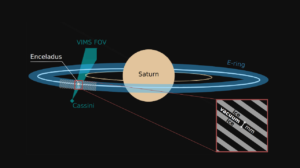
Source : astrobiology.com
II. The Moons: Habitability in the Outer Solar System
Saturn boasts the largest collection of known natural satellites, recently cementing its status with over 140 confirmed moons. Among this colossal lunar family, two stand out as prime candidates in the search for extraterrestrial life: Titan and Enceladus.
Enceladus: The Icy Water World
Enceladus, a relatively small icy moon, has become a top priority for astrobiologists.
- The Geysers of Life: Cassini discovered colossal plumes of water vapor and ice particles erupting from four parallel fissures near the south pole, nicknamed “Tiger Stripes.” These geysers originate from a vast, subsurface saltwater ocean situated beneath the icy crust.
- Chemical Signatures: Analysis of the plume material detected complex molecules, including methane and hydrogen, suggesting hydrothermal activity on the moon’s seafloor. This process—where hot rock interacts with liquid water—is a key prerequisite for life as we know it, potentially mirroring the deep-sea vents where life originated on Earth.
Titan: A Hydrocarbon Earth
Titan is Saturn’s largest moon and the only moon in the solar system with a thick, dense atmosphere.
- Liquid Lakes: Titan’s surface hosts stable bodies of liquid, not of water, but of liquid methane and ethane. This forms a complete hydrological cycle, with clouds, rain, rivers, and vast lakes, presenting a fascinating model of a world where water is replaced by hydrocarbons.
- Prebiotic Chemistry: Its dense, nitrogen-rich atmosphere, rich in complex organic molecules, acts as a natural laboratory for studying prebiotic chemistry—the chemical steps that may lead to the origin of life. Future missions are being designed to explore these enigmatic hydrocarbon lakes directly.
III. Planetary Science and Internal Dynamics
Saturn itself is a gaseous giant, primarily composed of hydrogen and helium, lacking a defined surface. Its unique features challenge current models of planetary formation.
- The Hexagon: At Saturn’s north pole, a persistent, massive cloud feature known as “the Hexagon” rotates. This stable, six-sided jet stream is a weather pattern unlike anything seen elsewhere in the Solar System, moving at speeds of over 320 km/h, requiring complex fluid dynamics to explain.
- Energy Imbalance: Saturn radiates approximately 2.5 times more energy than it absorbs from the sun. This internal heat is generated by slow gravitational compression and potentially the “helium rain”—where helium separates from hydrogen deep within the core and precipitates, releasing enormous gravitational energy.
Conclusion: A High-Stakes Frontier
Saturn is a powerhouse of scientific inquiry. The $3.9 billion Cassini mission offered a treasure trove of data that continues to redefine our knowledge of gas giants, magnetospheres, and ocean worlds. The potential for extraterrestrial microbial life on Enceladus, combined with the complex chemical systems on Titan, cements Saturn’s position at the forefront of astrophysics. Further exploration is not just about mapping a distant planet; it is about seeking the definitive answer to the question: Are we alone in the universe?